

The Royal Sharara Look: A Complete Guide
From its Mughal court origins to today's wedding mandaps — the sharara suit has carried Indian women through every celebration for over four centuries. Here is everything you need to know.
Picture any big Indian occasion — a wedding baraat, an Eid evening, a Diwali gathering — and somewhere in that scene is a woman in a flared sharara suit that stops every conversation. Not because it demands attention, but because it carries something harder to manufacture: a sense of occasion that feels both personal and inherited.
What makes this outfit remarkable is its refusal to become dated. It has survived the rise of lehengas, the reign of anarkalis, and the return of pant suits — and each time it comes back a little richer, a little more confident. Understanding why requires going back to where it began.
The history behind the sharara suit
Born in the Mughal zenana
The sharara's lineage traces directly to the Mughal imperial court of the 16th and 17th centuries. Worn within the zenana — the women's quarters of the royal household — it was considered garb befitting queens and noblewomen. Empress Nur Jahan, one of the most powerful women of the Mughal era, is frequently credited with elevating and codifying the sharara's aesthetic: wide-flared trousers gathered at the knee, paired with a fitted short kameez and a translucent dupatta in fine muslin or silk.
The defining characteristic that separates a sharara from ordinary wide-leg trousers is the gathering point. A true sharara fits close at the hips and upper thigh before flaring dramatically from the knee downward — creating a bell-shaped leg that moves like water when you walk. This technical detail is also what distinguishes a sharara from a gharara, its close cousin, which gathers at the knee with a more pronounced ruffle and is generally associated with Hyderabadi and Deccani court styles rather than Lucknowi or Delhi tradition.
By the time of the Nawabs of Awadh in the 18th and 19th centuries, the sharara had migrated from royal courts into the wider aristocratic culture of North India. Lucknow became its spiritual home — and Lucknowi chikankari embroidery became its most beloved adornment.
Regional variations across India
One aspect that most styling guides overlook: the sharara is not a monolithic garment. It wears different identities depending on where in India it is made.
Knowing the regional origin of a sharara set helps you style it correctly. A chikankari sharara demands understated jewellery; a heavy zardozi piece can carry statement kundan sets without competition.
Why the sharara holds such deep cultural meaning
Fashion in India has always been layered with meaning beyond aesthetics. What you wear to a wedding communicates your relationship to the occasion, your family's aesthetic identity, and your own sense of celebration. The sharara occupies a particular emotional register — it says I dressed for this. This moment matters.
There is also something specific about the garment's movement that creates presence. The wide flare of a silk or georgette sharara set generates a natural swish with every step — the kind of physical feedback that makes the wearer feel graceful rather than simply well-dressed. This is not a trivial distinction. The sharara is one of few traditional Indian garments where the experience of wearing it is as considered as the visual impact of seeing it.
Across generations, the sharara has also become a vehicle for heirlooms. A grandmother's dupatta repurposed as the odhni, a mother's silver payal worn with a new suit — the sharara accommodates inheritance elegantly, literally and otherwise.
Choosing the right fabric: a practical guide
The fabric of a sharara suit does more than set the tone — it determines how the garment drapes, how the flare behaves, and how comfortable you will be across a six-hour wedding function. Most guides skip this, so here is a straightforward breakdown:
How contemporary designers are reinterpreting the sharara
Tradition meeting modern tailoring
Today's sharara suit market spans a wide spectrum — from faithfully traditional Lucknowi chikankari pieces to sharply structured jacket-style sets that blur the line between ethnic and contemporary fashion. What has changed most noticeably over the past decade is not the silhouette, which remains intact, but the proportion.
Contemporary designs tend to shorten the kameez — sometimes dramatically, to mid-thigh or even crop length — which emphasises the sharara flare and gives a younger, more dynamic silhouette. The dupatta has also evolved: where traditional styling drapes it over both shoulders symmetrically, modern wear often uses it as a trailing element, pinned at one shoulder or anchored at the wrist.
Other significant contemporary shifts include:
Importantly, these modern adaptations have not diluted the sharara's identity. They have expanded who it speaks to — which is exactly why it continues to find new audiences with each generation.
Five sharara looks worth trying, matched to occasions
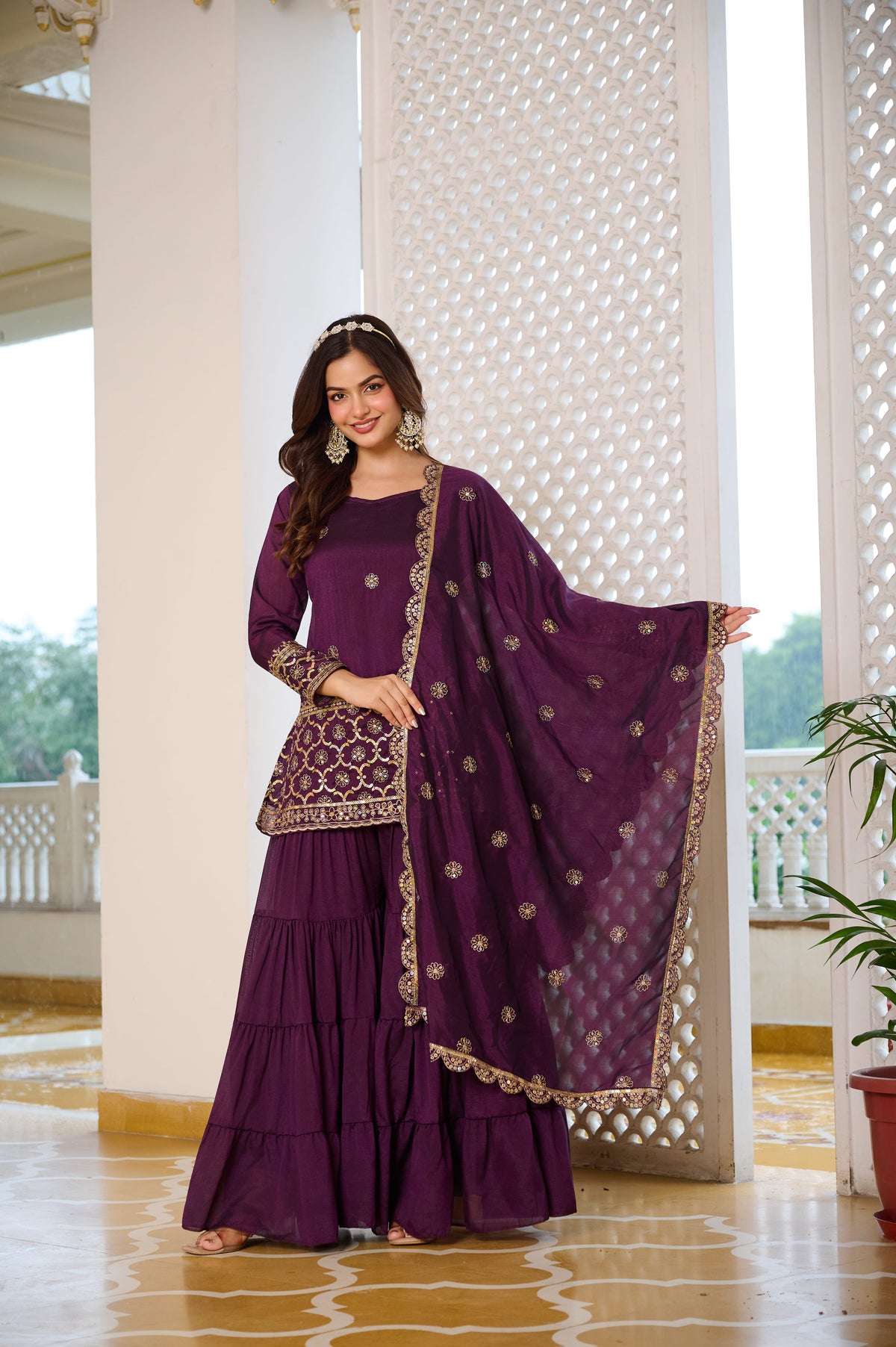
Deep wine, emerald green, or midnight navy velvet with gold zari borders reads as genuinely regal. The fabric's density means it photographs exceptionally well under the warm lighting of a wedding mandap. Pair with heavy polki or kundan jewellery and avoid large bags — the outfit is the entire statement. Best for November through February weddings in North and Central India.
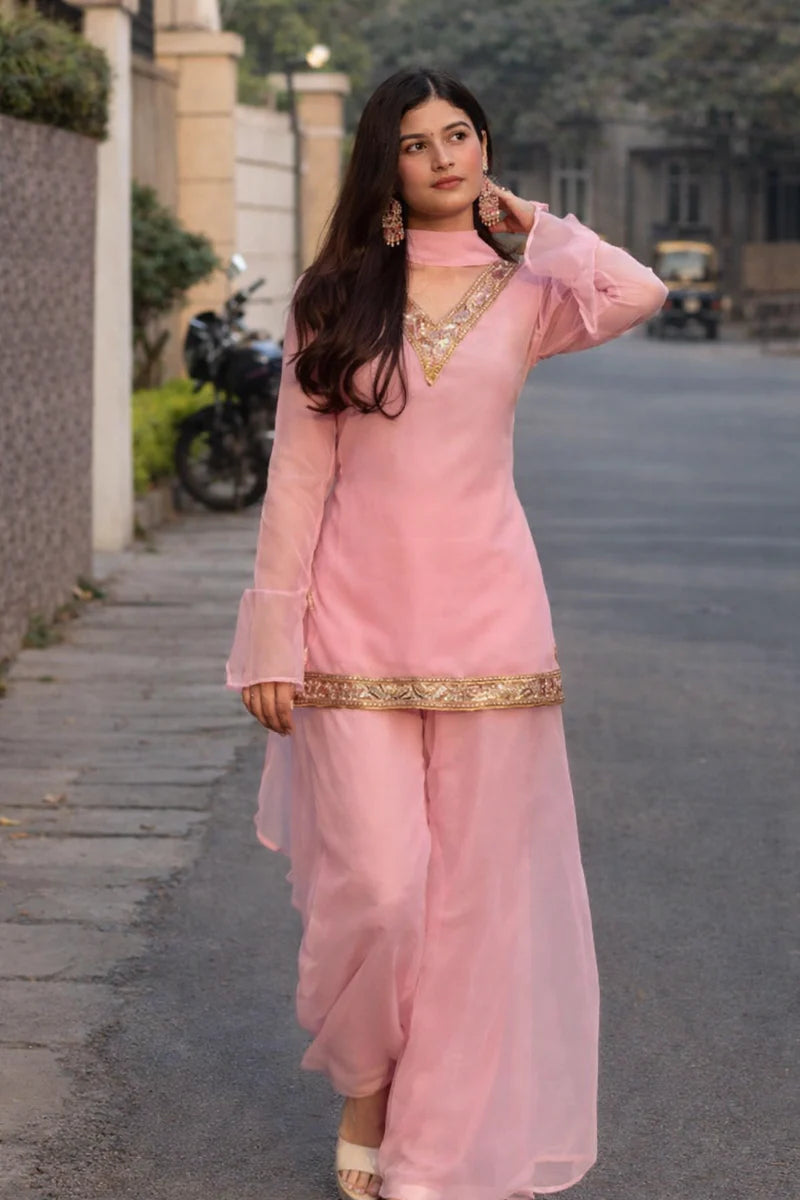
Blush, mint, and powder blue organza shararas carry an almost luminous quality in natural light — ideal for daytime ceremonies where outdoor photography is part of the plan. Light mirror work or mukaish detailing adds sparkle without weight. The pastel palette also photographs beautifully against greenery and white decor.
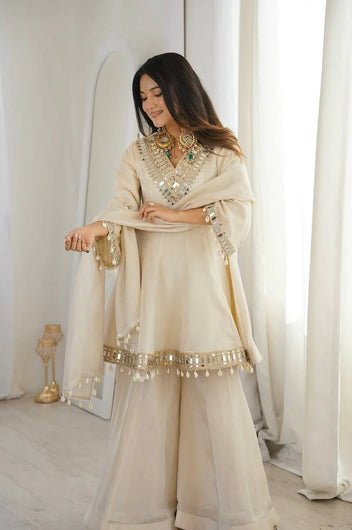
Mirror work — particularly the Rabari-style circular mirrors from Kutch — was designed to be seen in motion and firelight. At a sangeet or Navratri garba, it does exactly what it was built for: catching and scattering light with every turn. Choose cotton or georgette base fabrics so you can dance comfortably for hours without overheating.
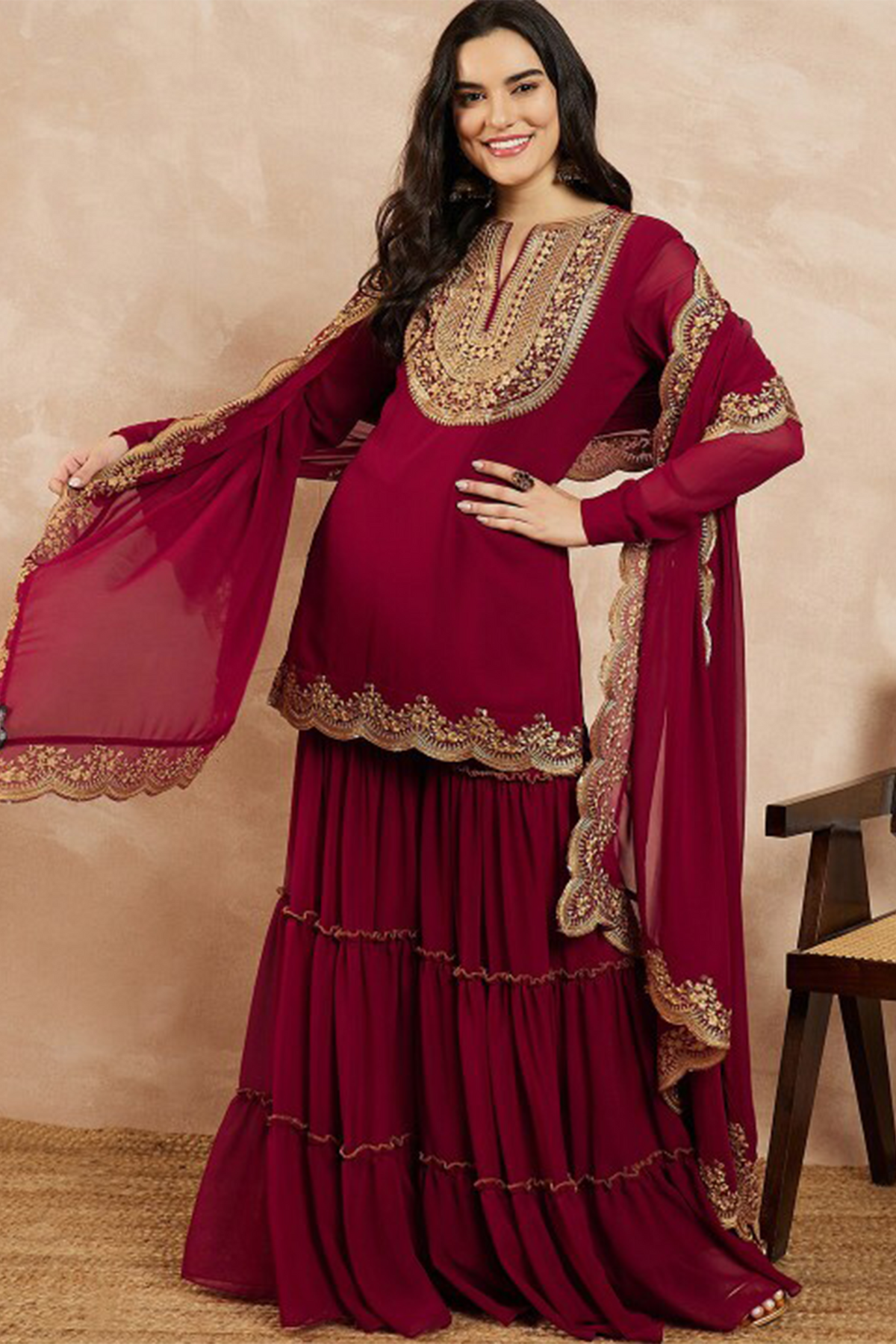
Zardozi, resham, and sequence-on-silk combinations create the full ceremonial weight that a wedding reception or baraat reception demands. This is the sharara as wearable architecture — structured, deliberate, and unforgettable. Keep hair and jewellery restrained so the embroidery reads clearly; a tight bun or braided updo works better than loose curls with heavily worked fabric.
An embroidered long jacket — cut like an angrakha or straight bandhgala — over a plain sharara provides structure and a distinctly contemporary sensibility. This works particularly well for ring ceremonies and cocktail functions where guests want to look dressed up without defaulting to full bridal weight. The jacket can often be re-worn independently over jeans or a plain churidar, making it a practical investment piece.
Shop the sharara collection
How to style a sharara suit: what the guides usually miss
Match jewellery weight to fabric weight — not to personal preference
The most common sharara styling mistake is wearing heavy jewellery with heavily embroidered fabric, or wearing delicate pieces with a plain base. The principle is balance: the total visual weight of outfit and accessories should read as roughly equal. A dense zardozi sharara set already carries its own grandeur — forcing a statement necklace into that space creates visual noise rather than impact. Stick to long jhumkas, a simple maang tikka, and clean bangles. Conversely, a plain pastel georgette sharara can carry a full set of kundan or polki without looking overdressed.
The dupatta is a styling tool, not an afterthought
There are at least four distinct ways to drape a sharara dupatta, each creating a different silhouette and formality level. For the most traditional look, the dupatta is draped across both shoulders and allowed to fall to mid-calf at the back — this works for formal ceremonies and bridal settings. For a modern interpretation, pin it at one shoulder and let it drape diagonally — this creates asymmetry and works well for functions where movement matters. A third option, popular at mehndi events, is to tuck one end into the sharara waistband and drape the other over a single arm — freeing both hands while keeping the dupatta in the composition. The fourth, increasingly popular among younger wearers: wear it as a head covering for religious ceremonies, then re-drape to one shoulder for the reception that follows.
Footwear: the rule about the flare
Because the sharara covers the foot almost entirely when standing, footwear is often underestimated. But it matters for three reasons: height, sound, and the walking experience. A small heel (2–3 inches) keeps the hemline from dragging and creates a cleaner silhouette — particularly important for velvet and silk shararas that are cut to a precise length. Flat mojaris or juttis work beautifully with lighter fabrics like cotton and georgette, where the hem naturally floats above the ground. Kolhapuris are an excellent choice for mehndi and outdoor day events — they are robust and pair naturally with the artisanal aesthetic of embroidered ethnic wear.
A word on fit: the one alteration that changes everything
Most ready-to-wear sharara suits are designed for a standard waist and hip measurement but sold in a single length. The single most valuable alteration you can make is adjusting the trouser length — specifically, ensuring the flare begins at your knee, not above or below it. If the gathering point sits too high, the sharara reads as a wide-leg palazzo. Too low, and the flare collapses. A skilled tailor can relocate the gathering point in under an hour, and the visual difference is transformative.
Five common sharara mistakes — and how to avoid them
The sharara's wide flare moves independently of the body — which means fitted undergarments matter more than with other ethnic silhouettes. Avoid structured shapewear that cuts into the waist and distorts the line of the kameez. A smooth, seamless brief and a well-fitted blouse lining are all that is needed.
Large potli bags, oversized clutches, and statement belts all compete with the sharara's own volume. A small embroidered minaudière or a slim chain handle bag sits within the aesthetic without disrupting it.
Steam is the correct method for all sharara fabrics. Direct iron contact crushes velvet pile permanently and damages embroidery threads. Hold a steamer 3–4 inches from the fabric surface and work from the inside of the garment outward for best results.
Heavily sequinned or mirror-work shararas photograph brilliantly but can look overwhelming in person at intimate indoor gatherings. Consider the venue and lighting before choosing embellishment density — what dazzles under direct flash can feel harsh under warm indoor light.
Taller women can carry longer kemizes; shorter women generally look more balanced with hemlines at mid-thigh or above. The goal is to let the eye read the flare as the dominant design element — a kameez that reaches the knee can obscure the sharara's silhouette entirely.
Caring for your sharara suit: fabric-specific guidance
Ethnic Indian festive wear is almost always an investment — both financially and sentimentally. Proper care extends the life of the garment significantly and preserves the embroidery that makes it special.
| Fabric | Washing | Storage | Key caution |
|---|---|---|---|
| Georgette & chiffon | Dry clean only; hand wash only if label permits, cold water | Hang on padded hanger or fold gently | Do not wring — always press between towels |
| Silk (raw, Banarasi) | Dry clean strongly recommended | Wrap in muslin or cotton cloth, not plastic | Sunlight degrades silk fibre — store away from windows |
| Velvet | Dry clean only — water causes pile damage | Hang in breathable garment bag | Never fold velvet along pile grain — creates permanent crease |
| Organza | Dry clean or very gentle cold hand wash | Fold with tissue paper between layers | Organza creases permanently under pressure — store loosely |
| Cotton & Chanderi | Hand wash in cold water; mild detergent | Fold normally; cedarmoth sachets recommended | Avoid soaking embroidered sections for extended periods |
| Embroidered (all types) | Turn inside-out before any wash; dry clean preferred | Never store in compressed bags | Thread oxidisation can cause discolouration — air after each wear |
Why women keep returning to the sharara, generation after generation
There is a question worth asking directly: in a market full of lehengas, anarkalis, sarees, and fusion silhouettes, why does the sharara command such lasting loyalty? Part of the answer is practical — it is comfortable across a long function, it flatters a wide range of body types, and it offers the kind of visual drama that photographs beautifully without requiring a team to help you sit down.
But the deeper answer is cultural. The sharara is one of the few Indian garments with a documented aristocratic lineage that has genuinely democratised — it moved from Mughal courts to nawabi households to middle-class family celebrations without losing its sense of occasion. When you wear a sharara to a wedding, you are participating in an aesthetic tradition that stretches back four centuries and forward to your niece who will ask to try it on.
There is also the specific memory it carries. For many Indian women, their first memory of feeling truly dressed up — at a cousin's wedding, at an Eid dawat, at a school cultural programme — involves a sharara. The garment holds that first feeling of adulthood, of occasion, of being seen. That is not something a seasonal trend can replicate.
The sharara suit: timeless because it earns it
Timelessness in fashion is not a passive quality — it has to be earned. The sharara has earned it by being genuinely beautiful, genuinely comfortable, and genuinely connected to something larger than any one season's preferences.
Whether you are drawn to a traditional sharara set with hand-done chikankari, a contemporary jacket-sharara combination for a modern wedding, or a velvet sharara that will photograph like a painting under warm evening light — the choice you are making is not just sartorial. You are choosing to carry a craft tradition forward, in the most personal way available: on your own body, at a moment that matters.
That is what we mean when we call it royal — not the price, not the embroidery, not even the history. We mean the way it makes you carry yourself when you walk into the room.

