

Mughal Fashion & The Sharara: How a Royal Silhouette Became India's Festive Staple
The moment a sharara outfit moves — that wide, flared sweep of fabric catching the light — you understand why this silhouette survived four centuries. It began in Mughal courts and it still belongs at every Indian wedding today.
Clothes That Carry Memories
In Indian homes, there are clothes you buy and clothes you keep. The bought ones get donated, resold, or forgotten. The kept ones sit folded in the back of an almirah and come out only on specific occasions — a wedding, an Eid, a daughter's first function. The sharara outfit is almost always one of the kept ones.
This is not an accident. Shararas carry a particular kind of weight: the embroidery is heavy enough to feel precious, the flare wide enough to feel festive, and the silhouette old enough to feel connected to something larger than just fashion.
That "something larger" is Mughal fashion — a tradition of dressing that built some of the most distinctive textile culture in Indian history. Understanding where the sharara comes from helps explain why it still feels so right at a mehendi or a nikah nearly 400 years after the style first took shape.
What Mughal Fashion Actually Was
Mughal fashion was a working synthesis of Persian court dress and North Indian textile tradition — two distinct visual languages that, over roughly 150 years from Akbar's reign through Aurangzeb's, produced something neither culture had made alone.
From Persia came the love of layered silhouettes, intricate surface pattern, and the use of katan silk and velvet as prestige fabrics. From the Indian side came specific embroidery vocabularies — the zari goldwork that still appears on sharara suits today, the gota-patti borders of Rajasthan, the chikankari whitework of Lucknow — and an understanding of how fabric behaves in India's climate and light.
What made Mughal court dress distinctive was the proportion of ornament to silhouette. The clothes were deliberately generous in cut — wide pajamas, flowing jamas, heavy dupattas — so that the embroidery had space to be seen. The sharara inherits this logic directly: the flared lower half exists, in part, to display the work done on it.
Women's dress in the zenana followed its own rules. Documentary evidence from miniature paintings and accounts by travelers like François Bernier show long kurtis over wide-legged bottoms, layered with finely embroidered odhnis. The sharara outfit — wide flared trousers distinct from the straight-cut churidar — developed within this tradition.
Where the Sharara Outfit Fits In
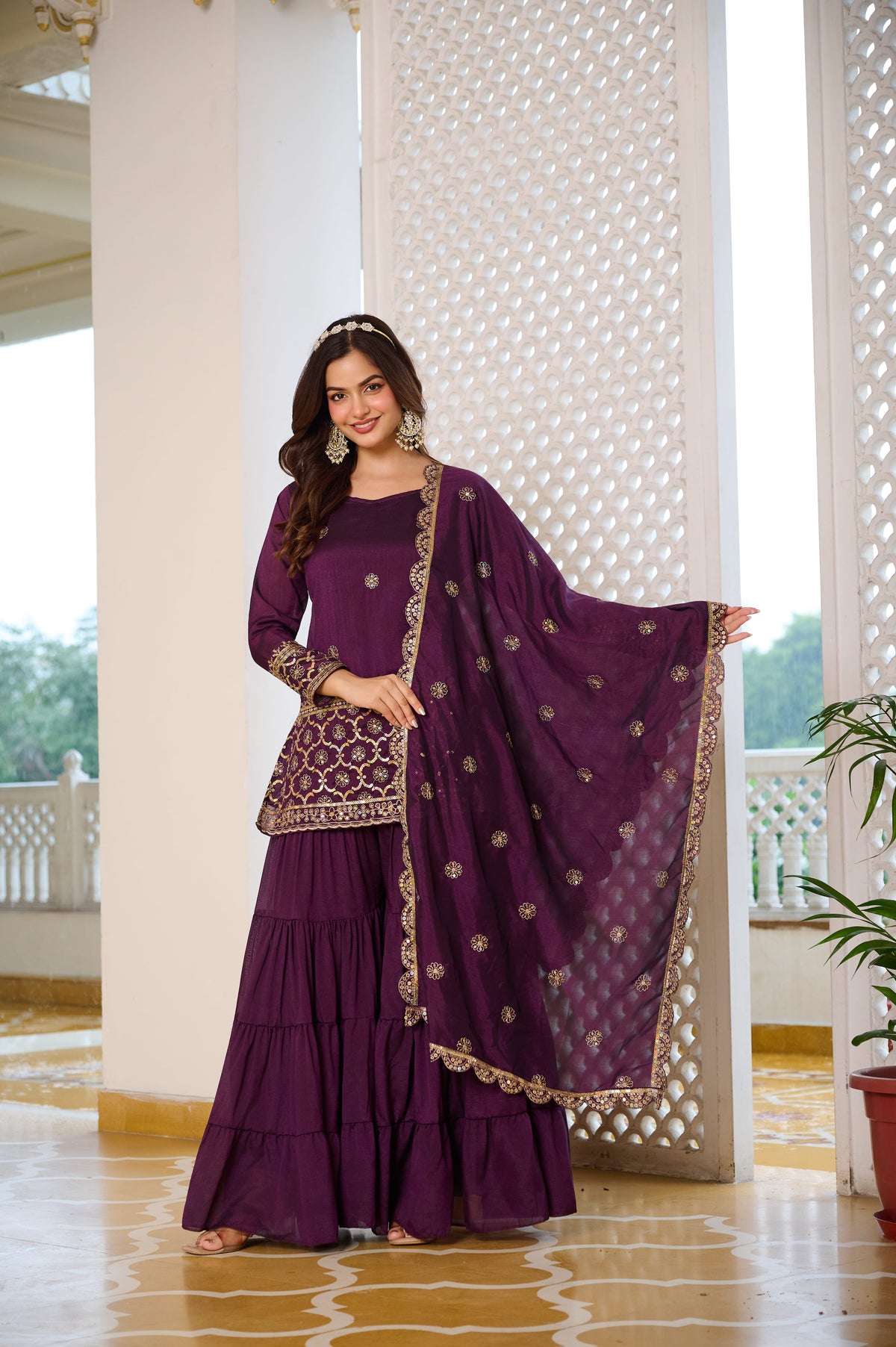
A sharara is defined by one structural feature: the trousers flare dramatically from the knee downward. Not at the hip, not from the waist — from the knee. This creates the characteristic bell shape that distinguishes it from a palazzo (which flares from the waist) and a gharara (which has a gathered seam at the knee creating a separate flounce).
That specific cut places it in the context of Mughal court dress, where wide-bottomed trousers were standard for women's festive wear. The sharara survived long after the Mughal period because it solves a practical problem particularly well: it is comfortable to sit in, move in, and wear for the length of an Indian wedding — while still looking ceremonial.
Its staying power across all these occasions is a direct result of that Mughal design logic: generous cut, surface embellishment, fabrics that hold their shape. The style was built to last a full day of celebration, and it still does.


The Sharara's Origin Story
The sharara as a named and distinct garment crystallized in the textile culture of Lucknow and the broader Awadh region — the post-Mughal cultural successor states where court dress traditions survived and evolved through the 18th and 19th centuries.
Lucknow's chikankari embroiderers adapted the wide-trouser silhouette for the nawabi court's taste for refinement and understatement. The embroidery on Lucknowi sharara suits is typically white-on-white or pastel — delicate shadow work rather than the gold-heavy zardozi of the Mughal period. This local adaptation is part of why the sharara as a category is so varied: it absorbed regional textile identities wherever it traveled.
The garment traveled into wider Indian Muslim household culture through wedding trousseau traditions. A girl's wedding outfit in many North Indian and Hyderabadi families included a sharara as standard for decades — sometimes made in the family, sometimes commissioned from specialist darzi families who knew the construction inside out. This is where the sharara became less a court garment and more a cultural one.
By the 20th century it had appeared in Bollywood — notably in films set in Mughal or Nawabi contexts — which gave the style a second wave of visibility with audiences far outside its original geography. Today a sharara outfit reads as "festive North Indian" to most of India, which is a remarkably wide diffusion for a garment with such specific origins.
Traditional vs. Modern Sharara: What Changed
The sharara has not stood still. Each generation of wearers and makers has adjusted the silhouette to match available materials, current taste, and different body preferences. Here is what actually shifted and what stayed constant.
| Element | Traditional Sharara | Contemporary Sharara Suit |
|---|---|---|
| Kurti length | Floor-length or near-floor anarkali | Shorter — knee to mid-thigh — for ease of movement |
| Flare point | From the knee, dramatic bell | Still from the knee; sometimes slightly higher for a softer silhouette |
| Embroidery style | Zardozi, chikankari, heavy gold zari | Zari, gota-patti, resham, cut-dana, mirror work — often mixed |
| Fabric weight | Heavy silk, velvet, brocade | Lighter georgette, net, organza — easier to drape and wear long |
| Colour palette | Deep royal tones: crimson, indigo, forest green, ivory | Pastels added; royal tones remain most popular for weddings |
| Dupatta | Heavily worked, worn over head | Still embellished; worn draped over shoulders or arm |
The core proposition — wide flared trousers, ornate embroidery, dupatta — has not changed. What modern designers adjusted is weight and practicality, not character.
Why Mughal-Derived Styles Still Drive Indian Wedding Fashion
Indian bridal wear is not a market that chases trends the same way Western fashion does. A bride who invests in a sharara suit set for her mehendi expects it to still look right in photographs twenty years later — which means she is drawn to styles with documented staying power, not runway novelty.
Mughal fashion gives designers and buyers exactly that: a visual vocabulary with centuries of proof behind it. When a contemporary sharara outfit uses emerald green, gold zari, and velvet trim, it is not imitating the past — it is drawing on a colour and material language that has been refined over 300 years of Indian festive wear.
There is also a practical dimension. Heavy Mughal-inspired embroidery photographs beautifully. In an era where wedding photography matters enormously to Indian families, a garment that captures light richly and holds its shape across a full day of ceremony has a real advantage.
How Designers Actually Work With Mughal Heritage
Contemporary designers who work in the heritage ethnic wear space do not simply reproduce historical garments — that would produce museum pieces, not wearable fashion. What they do is selective: lift the elements that still function (the silhouette, the embroidery vocabulary, the colour logic) and update everything that doesn't (weight, construction, sizing consistency).
In practice this means a designer making a sharara suit today might use a Georgian silk to get the richness of historical brocade at a fraction of the weight. They might combine zari work with contemporary cut-dana embellishment to get the sparkle that registers well in phone photography. The kurti might be cut shorter to work with modern footwear rather than nagra juttis.
The result is a garment that reads as "Mughal-influenced" to anyone who sees it — not because it is historically accurate, but because the designers preserved the right cues: wide flare, surface ornament, jewel tone, dupatta. These are the signals that Indian wedding guests and brides have been reading for generations.
This is also why the sharara outfit has proven more durable than other heritage-revival trends. Unlike some styles that return briefly as novelty and fade, the sharara never actually left the market — it simply expanded from its original North Indian and Muslim-majority household context into mainstream Indian wedding fashion over the past three decades.
The Emotional Side of Traditional Dressing
There is a specific kind of weight a sharara has when you pick it up — the embroidery is dense, the fabric has body, the dupatta takes both hands to fold properly. That physical weight does something. It slows you down. You are not throwing on an outfit; you are getting dressed.
Indian families understand this. The careful putting on of a sharara before a wedding function is a ritual with its own grammar — the mother adjusting the dupatta, the younger sister checking the hem, the argument about which earrings work. The garment organizes the occasion as much as it dresses the wearer.
This is the part of Mughal fashion that no audit of embroidery technique or silhouette history fully captures: it transmitted a set of behaviors along with the clothes. Dressing carefully, taking time, marking celebration with weight and ornament. These habits traveled with the garment across centuries and they still show up at Indian weddings every weekend.
When a woman chooses a sharara for a mehendi or a family function, she is almost certainly not thinking about Awadhi court culture or Persian textile influence. But the garment carries that history in its construction. The wide flare, the surface embroidery, the matching dupatta — these are not decorative choices made fresh each generation. They are a form of continuity.
Common Questions About Sharara Outfits
Find Your Sharara
Each piece in the collection is made with the embroidery traditions and silhouettes that gave the sharara outfit its staying power — zari work, deep jewel tones, fabrics that move. From teal to emerald to maroon, built for Indian weddings and every function around them.
Explore the Full Collection
